12 Busan Photography Spots for Instagram (2026 Local Picks)
Skip the Gamcheon Culture Village crowds. Discover where Busan locals actually photograph—hidden coastal cliffs, neon-soaked alleyways, and industrial-chic ware
# 12 Busan Photography Spots for Instagram (2026 Local Picks)
Busan isn't Seoul. It's messier, saltier, and infinitely more photogenic—if you know where to point your camera. While Instagram's algorithm still rewards the same five "must-see" spots that appear in 10,000 feeds weekly, the real Busan photography scene lives in the margins: forgotten piers, neon-drenched side streets, and waterfront angles that most tourists never discover. This guide picks spots that offer more originality than another filtered cliché.
Beyond Cliché Shots—What Busan Locals Actually Post
Forget Gamcheon Culture Village at peak hours. Yes, it's colorful. Yes, you'll get likes. But you'll also get 200 people in your frame trying to do the exact same shot. Busan's photography culture is shifting toward raw industrial textures, asymmetrical compositions, and golden-hour maritime light that the city's harbor geography naturally produces.
Locals are posting:
- Abandoned warehouse districts with peeling paint and rusted metal—Amnam-dong and parts of Suyeong-gu deliver moody, authentic urban decay without the tourist infrastructure.
- Pier-level perspectives where fishing boats, shipping containers, and architectural geometry collide. The angle matters more than the subject.
- Night neon in unexpected neighborhoods—not the organized chaos of tourist nightlife, but the scattered, chaotic beauty of local pachinko parlors, pojangmacha (street food tents), and convenience store signs reflecting on wet pavement.
- Tidal formations and rock formations along the coast that change dramatically between seasons. These aren't Instagram-famous, which is precisely why they're worth shooting.
12 Busan Photography Spots: Insider Coordinates
What you'll shoot: Layered rock formations, distant bridge silhouettes, and light refraction on water. This isn't a single photo op—it's a 2km walking path where every 50 meters presents a completely different composition.
Why locals prefer it: The light hits differently here because of the park's eastern exposure. Early morning (5:30–7:00 AM) delivers soft, diffused golden hour. No entrance fee. Parking: 2,000 KRW per hour.
Best time: May–June and September–October. Summer heat + humidity = hazy, soft light (good if intentional; bad if you want crisp details).
What you'll shoot: Dramatic 200-meter coastal cliffs, lighthouse, and maritime vistas. The "red cliff" rock formations photograph exceptionally well during overcast afternoons when the sky turns steel-gray.
Why locals prefer it: It's technically a paid attraction (3,000 KRW) but genuinely worth it because the park boundaries protect the area from overdevelopment. Cable car rides down the cliff provide unique elevated perspectives.
Practical note: Bring a polarizing filter. The ocean reflection will thank you.
What you'll shoot: Industrial maritime infrastructure, fishing boats, stacked shipping containers, and weathered wooden pilings. This is where Busan's working harbor aesthetic still exists.
Why locals prefer it: Zero tourists. Zero signage in English. Zero Instagram hashtag saturation. Just working fishermen, salt-crusted timber, and authentic maritime grit. Free. No official hours—visit 5:00–8:00 AM when fishermen are active.
Photography note: Telephoto lens (70–200mm) isolates texture and compresses depth. Wide-angle distorts but captures the chaos beautifully.
What you'll shoot: Neon signs (both lit and unlit), narrow Korean alleyways, peeling storefronts, and the visual chaos of an unglamorous but entirely authentic neighborhood. The 1960s–80s architecture still dominates here.
Why locals prefer it: This area is actively gentrifying, so you're photographing a rapidly disappearing Busan. Urgency = better photos. Free. Street food costs 5,000–8,000 KRW if you want to set up a tripod and wait for good light.
Best time: 6:00–9:00 PM. The neon-to-daylight ratio is perfect. Avoid weekends (too crowded with local drinkers).
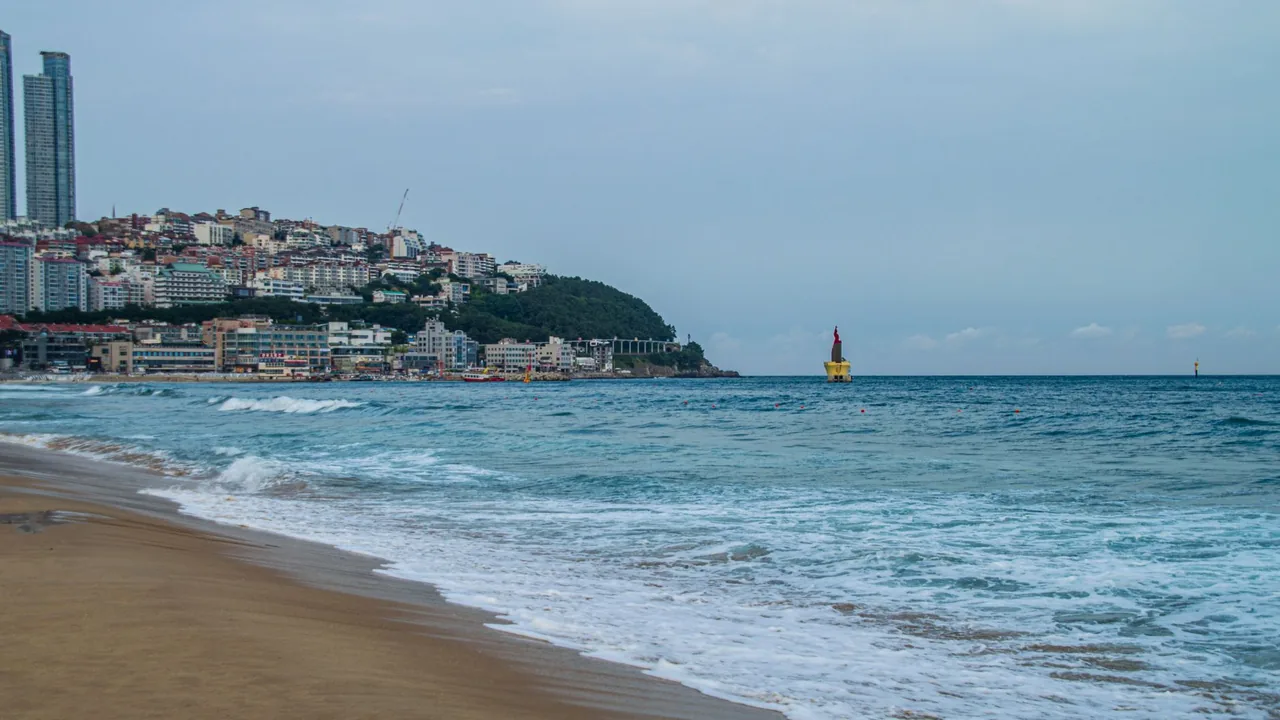
What you'll shoot: Beach geometry, wave patterns, cliff-to-sand transitions, and occasional surfers silhouetted against sunset. It's less famous than Haeundae Beach proper, which makes it exponentially better for photography.
Why locals prefer it: The cliffs create natural frames. The surf break changes the water's surface texture minute-by-minute. Parking: 2,000 KRW. Free beach access.
Gear tip: Neutral density filter if you want to blur water movement. 30-second exposures create a painterly effect.
What you'll shoot: Subway tile aesthetics, architectural repetition, crowds moving in geometric patterns, and surprising pockets of creative street art on platform walls. Urban geometry that reads abstract on camera.
Why locals prefer it: Natural light filters through the skylights at specific hours (10:00–11:00 AM). Pedestrian traffic provides human scale without feeling crowded. Free. Metro card required (1,000 KRW minimum).
Pro move: Shoot from platform-level upward to capture the architectural repetition and light shafts.
What you'll shoot: Colorful fish tanks, market signage chaos, ice sculptures, and vendors gutting seafood. This is organized sensory overload—texture-heavy, color-saturated, entirely authentic.
Why locals prefer it: 40 minutes by car from downtown, but worth it. Your average Instagram traveler doesn't know it exists. Street food: 8,000–15,000 KRW. Parking: free.
Timing: 9:00 AM–1:00 PM. Afternoon light is harsh; early morning light is soft but the market's less active.
What you'll shoot: Elevated city views, harbor sprawl, and mountain-meets-ocean geography that defines Busan's layout. Not unique, but technically essential for context shots.
Why locals prefer it: 10,000 KRW admission. Go at 5:00–6:30 PM for the transition between daylight and city lights. The window reflections are problematic; bring a lens hood.
What you'll shoot: Yacht clubs, modern architecture, manicured waterfront design, and the visual contrast between luxury and the working harbor beyond. Minimalist compositions work exceptionally well here.
Why locals prefer it: Quieter than tourist-dense areas. Free. The blue hour (6:30–7:15 PM) produces cool-toned, moodier compositions.
What you'll shoot: Traditional Korean architecture, hanging laundry, narrow staircases, and the lived-in chaos of a genuine residential neighborhood. Less sanitized than Gamcheon but with similar visual appeal.
Why locals prefer it: Real people live here. Respect that in your framing. Free. Visit Tuesday–Friday afternoons when fewer residents are around.
What you'll shoot: Art deco stadium architecture, residential density, and overlapping rooflines that create abstract geometric compositions. Early morning light rakes across the facades beautifully.
Why locals prefer it: Nobody photographs this. Genuinely underrated. Free. 6:00–7:30 AM optimal light.
What you'll shoot: Sunset over water (west-facing beach, so golden hour arrives here), fishing nets, small boats, and the industrial landscape of Busan's western periphery. Wide-angle landscapes are the default here—try portraits with the industrial backdrop instead.
Why locals prefer it: Far from downtown (45 min by car), so it filters out casual tourists. Parking: 2,000 KRW. Best visited in September–October when humidity drops and golden hour light becomes crisp.
8 Practical Photography & Etiquette Rules for Busan
- Respect working areas. Piers, markets, and fishing areas are functional spaces, not photo sets. Don't block people. Don't touch their equipment. A quick "안녕하세요" (hello) before shooting strangers costs nothing and opens doors.
- Sunrise = fewer people, better light. Busan's early morning light (5:30–7:00 AM) is underrated. You'll have parks and piers almost entirely to yourself. Bring a headlamp; some areas lack street lighting.
- Seasons matter differently here. Spring (April–May) brings soft haze and cherry blossoms near water features. Autumn (September–October) delivers crystal-clear light and minimal humidity—book accommodations early. Summer is humid and hazy (intentional filters exist). Winter is cold and windy but produces dramatic gray-skies and sharp shadows.
- Polarizing filters are non-negotiable. A 77mm or 82mm circular polarizer (20,000–40,000 KRW at Korean camera shops) eliminates water reflection glare and saturates sky colors by 20–30%. This single purchase will improve 60% of your Busan shots.
- ND filters extend your options. Want to blur water or smooth out busy pedestrian areas? A 10-stop ND filter (15,000–30,000 KRW) enables 30–60 second exposures in daylight. Game-changer for minimalist compositions.
- Always ask before photographing people. Point to your camera, smile, and use hand gestures. Koreans respect consent. If someone says no, move on immediately without argument.
- Lighting changes every 15 minutes. Don't spray-and-pray. Arrive early, scout the location, understand where the sun will be at your target time, and compose before the light hits. Intentional shooting beats random luck.
- Weather apps are your friend. Download Naver Weather or Kakao Map's weather integration. Overcast skies are often better for textures and colors than blue skies. Plan accordingly.
FAQ: Busan Photography Questions Answered
Q: What's the best time of year to visit Busan for photography? A: May and September–October deliver the optimal combination of clear skies, comfortable temperatures, and low humidity. May offers cherry blossom contexts near water; autumn provides crisp, high-contrast light ideal for detail work and architectural shots. Summer (June–August) is humid and hazy but works well if you lean into soft, moody aesthetics. Winter (December–February) is underrated—cold air creates sharp shadows and dramatic gray skies, perfect for minimalist compositions. Avoid early June (rainy season) and late July–August (peak heat and tourist crowds).
Q: Do I need expensive camera gear to shoot good photos in Busan? A: No. A smartphone with a decent computational photography engine (iPhone 13 Pro and newer, Pixel 6 and newer, Samsung Galaxy S24) will outperform a basic DSLR in dynamic range and color science. If you have a mirrorless camera or DSLR, a 24–70mm zoom lens covers 95% of these locations. Filters (polarizing, ND) matter far more than body price. Budget 50,000–80,000 KRW for essential filters and you'll see immediate improvement.
Q: Are there photography workshops or guides in Busan? A: Yes, but most operate in Korean. Naver and Kakao Naver offer local photography meetup groups (검색 "부산 사진" for Busan photography). English-speaking guides exist but are sporadic. Your better bet is hiring a local fixer (1:1 guide services run 80,000–150,000 KRW for 3–4 hours) through Airbnb Experiences or TimeOut's local partnerships. For serious photographers, consider visiting during photography festivals (Busan International Film Festival in October includes photo-adjacent events).
Q: What's the Instagram hashtag landscape for Busan photography? A: #부산 (Busan in Korean) has 3+ million posts—impossible to compete in. Niche hashtags like #부산야경 (Busan night view), #부산항 (Busan harbor), #부산골목 (Busan alleyway), and #부산해변 (Busan beach) range from 50K–500K posts—more discoverable. English hashtags (#busan, #busanphotography) are oversaturated. Strategy: use 3–4 mega-hashtags, 5–6 mid-tier niche tags, and 8–10 ultra-specific location tags (#amnampark, #taejongdae, etc.). Captions matter more than hashtags in 2026.
Q: What are common photography mistakes tourists make in Busan? A: (1) Only shooting during midday when light is harsh and shadows are deep. (2) Photographing the same angle as 50,000 prior visitors (yes, you'll get likes, but no originality). (3) Neglecting composition fundamentals and relying entirely on saturation/contrast filters. (4) Not respecting local privacy—avoid photographing children, street vendors, or people in vulnerable moments without consent. (5) Shooting RAW without understanding post-processing, then wondering why files look flat. (6) Ignoring weather as a compositional tool; overcast skies aren't failures—they're soft-light opportunities.
Q: Can I sell photos I take in Busan for commercial use? A: Most locations are public-access areas where personal-use photography is unrestricted. Commercial licensing gets complicated: paid attractions (Taejongdae, Busan Tower) may have licensing restrictions. Private businesses need explicit permission. Working ports and fishing areas should be treated as potential commercial spaces—ask first. Model releases are required for recognizable individuals. If you plan commercial use, budget 50,000–200,000 KRW per location for licensing or permits. Check with local tourism boards beforehand.
Final Thoughts
Busan's photography reputation lags behind Seoul's for no legitimate reason—the city's maritime geography, architectural texture, and genuine lack of Instagram saturation make it visually superior. You don't need 2,000 KRW to access these spots. You need intentional timing, basic understanding of light, and the willingness to wake up early or stay out past dinner.
The spots we've listed will yield strong, shareable images. But the real photos—the ones that actually represent Busan—live in the moments between these locations. The light reflecting on wet pavement. The fisherman's face. The color contrast between sky and water at 6:47 PM on a September evening.
Show up with patience. Shoot with intention. Respect the people and spaces you photograph. That's how you move beyond "Instagram spot" and into genuine visual storytelling.
Ask the KORLENS AI chat for Busan photo spot suggestions based on your interests. It is an AI assistant that replies in seconds, not a human team, and it works from Korea Tourism Organization open data. Also visiting Seoul? Seoul Local Picks covers Seoul only.
Next Step
About this guide
KORLENS is run by one person (KunStudio, a solo studio in Korea), not an editorial team. Guides are AI drafts based on public sources; some use Korea Tourism Organization TourAPI open data. KORLENS does not claim on-site visits or scheduled re-checks, so confirm hours, prices and closures with the venue before you go. Page last edited: 2026-05-24.
Plan your Korea trip with the KORLENS AI chat
Got a follow-up question after reading this? Ask the KORLENS AI chat in plain English. It is an AI assistant, not a person, and it replies in seconds with places from Korea Tourism Organization open data.
Ask the KORLENS AI chatCurious about Korean Saju? Try sajuapp.app
1,000-year-old Korean astrology, decoded by AI — available in 9 languages.
Is it worth visiting, the best time to go, crowds and real cost.
Best time to visit Busan, month by month →Busan on a Budget: How to Travel for KRW 100,000/Day in 2026
Skip the tourist traps. Busan locals spend KRW 100,000/day eating like kings and exploring like insiders. Here's exactly how.
Best Neighborhoods to Stay in Busan for Foreigners (2026 Guide)
Skip the tourist traps. We've mapped Busan's best neighborhoods for every trip style—from beachfront party zones to quiet local enclaves where you'll actually l